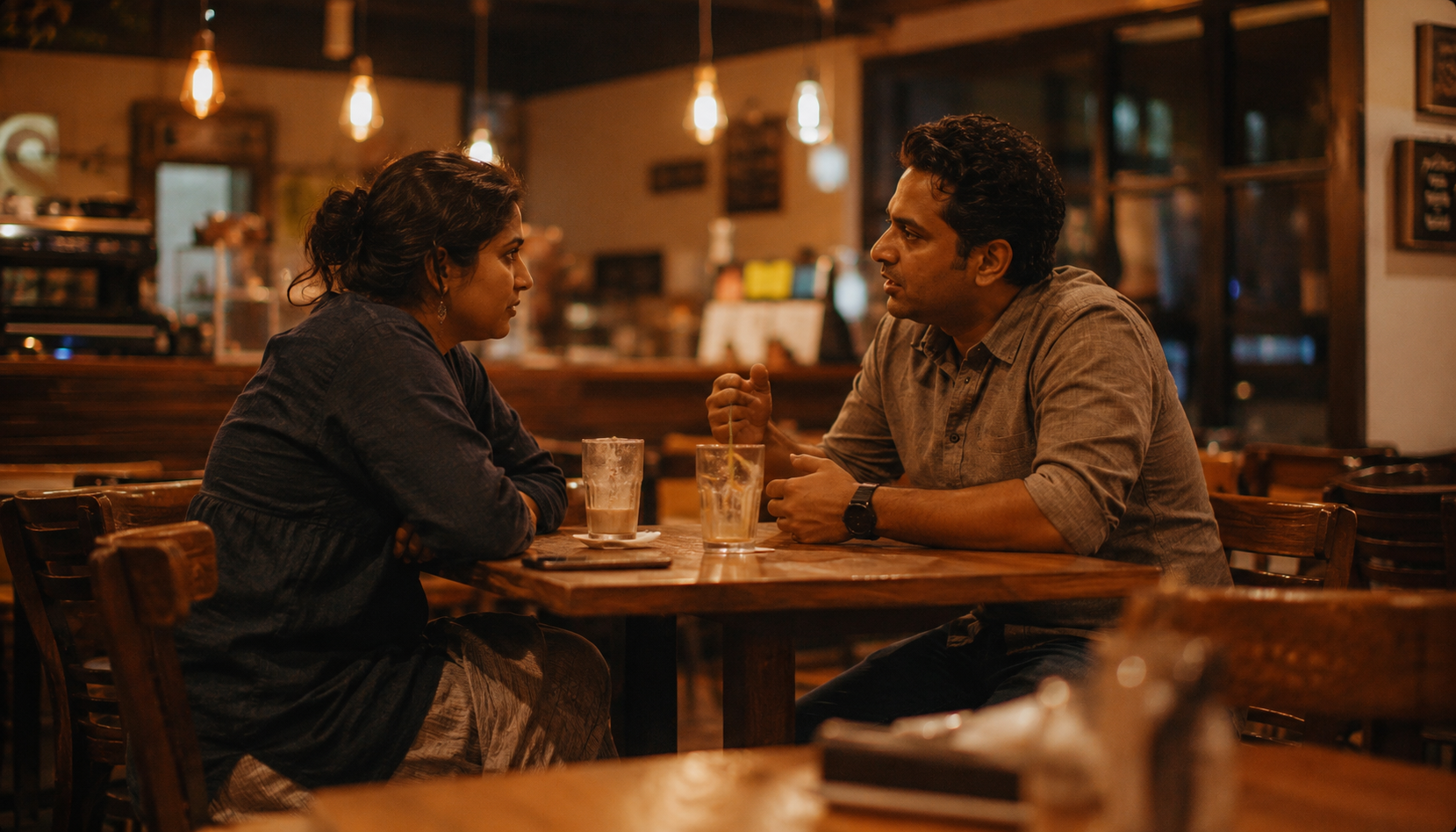
You've been on a first date that felt like a job interview. You know the one — questions lobbed across the table in even succession, each answered politely, then returned with a matching question of equal weight. Where do you work? Where did you grow up? Do you have siblings? How long ago did your last relationship end?
By the time the check arrives, you've exchanged facts without exchanging anything real. You know their city of origin, their job title, their gym schedule. You have no idea whether you like them. And that's the failure mode of the first date as information-gathering exercise: it optimizes for data when what you're actually trying to assess is something much harder to quantify.
Why the question-and-answer format doesn't work
When you treat conversation as a checklist, you're assessing compatibility — are we compatible on paper? — instead of connection — do I actually enjoy being around this person? These are related but not the same thing. People who look incompatible on paper have great relationships. People who check every box have terrible ones. The interview format sorts for the wrong thing.
There's also a social dynamic problem. Back-and-forth questioning puts both people in evaluative mode. You're scanning for red flags, they're trying to present well, and neither of you is actually present. The conversation becomes a performance review, not an experience shared. You leave not knowing if you had a good time — you know whether they said the right things.
The goal of a first date is narrower than most people think: not to gather enough information to make a decision, but simply to find out if you want to spend more time with this person. That's a feeling, not a calculation.
"The goal isn't to find out if you're compatible. It's to find out if you enjoy each other. Those are different things."
The follow-up question is the whole game
Here is the single most underrated first date skill: going deeper on what someone says instead of moving to the next question. When someone mentions they just got back from a trip, most people say "Oh nice, where?" and then proceed directly to their next prepared question. The better move is to ask something that makes them think — "Did it live up to what you expected?" or "Was there a moment that surprised you?" — and then actually listen to the answer.
Depth comes from staying in one topic long enough to find something real. If you're surface-skimming through seven topics in forty minutes, you're not having a conversation — you're conducting a survey. The most memorable first dates tend to have two or three subjects that got genuinely explored, not a dozen that got grazed.
Following up also demonstrates something important: that you were actually listening. That matters more on a first date than having a clever next question ready. People can feel the difference between someone who is waiting for their turn to speak and someone who is actually with them in the conversation.
Share about yourself without making it a performance
First dates often become exercises in subtle one-upmanship or competitive disclosure — I'll tell you something slightly vulnerable, you tell me something slightly more vulnerable, and we both feel like we're really opening up without actually having done anything of the sort.
The better version: when someone tells you something real, respond with something real of your own — not to match their vulnerability score but because it's the natural human thing to do. If they mention they've been feeling burned out, say something honest about your own relationship with your work right now, if that's genuine. Conversation becomes real when both people feel willing to say things that aren't curated.
You don't need to save your most interesting stories for the right moment. You don't need to manage impressions. You need to be recognizably yourself — with your actual opinions, your real taste in things, your honest sense of humor — and let them do the same. That's what creates the feeling afterward that the date was good.
How to read when someone's disengaged
Most signs of disengagement on a first date are legible if you're actually present: short answers given without follow-up questions of their own, eyes that settle behind your shoulder, the kind of polite laughing that doesn't reach the face. These aren't failures of chemistry — they might just be the natural fit between two people becoming clear.
The mistake is trying to course-correct by becoming more entertaining, louder, funnier. Chasing engagement on a first date is exhausting and rarely lands. If the conversation isn't finding its own rhythm by the end of the first drink, that information matters. It's not about anyone doing something wrong.
The date went well not when they said yes to a second — it went well when both of you were actually there for it. That's the only target worth aiming at.